
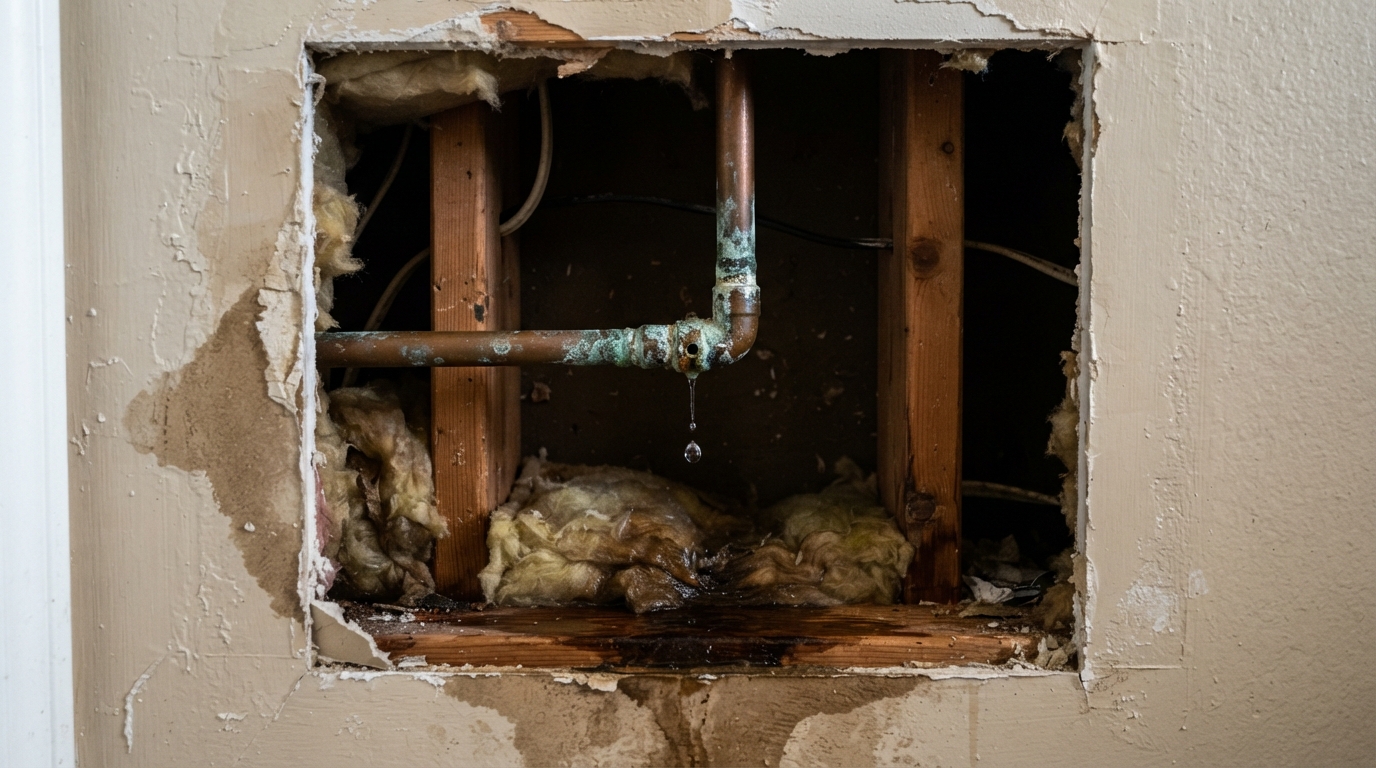
The Main Causes of Pipes Leaking Inside Walls
1. Corrosion — The Number One Culprit
Most in-wall leaks come down to corrosion eating through the pipe from the inside. With copper, this shows up as pinhole leaks: pitting corrosion slowly bores a tiny hole through a pipe that still looks perfectly solid on the outside. With older galvanized steel pipe, the inside rusts and scales until the wall gives out.
What drives copper pitting is usually the water itself. Aggressive water chemistry — low pH (acidic water), high dissolved oxygen, and the chlorine and chloramine disinfectants in treated municipal water — strips copper's protective inner layer and lets corrosion cut in. Because the cause is systemic, one pinhole leak often means more are coming on the same line.
2. Water Pressure That's Too High
High water pressure quietly wears out every joint, valve, and fixture connection in your home. California plumbing code requires a pressure-reducing valve (PRV) once incoming pressure passes 80 psi — because sustained pressure above that stresses the system and dramatically raises the odds of a joint failing or a supply line bursting inside a wall.
If your PRV has failed or you never had one, in-wall pressure spikes are working against your pipes around the clock.
3. Worn or Badly Made Joints
A pipe rarely fails in the middle of a straight run — it fails at the connections. Fittings, soldered joints, and threaded connections are the weak points. Common triggers:
- •Installation mistakes — too much solder or flux left inside a copper joint corrodes it from within; over-tightened threads crack.
- •Galvanic corrosion — copper touching a dissimilar metal without a dielectric union corrodes at the connection.
- •Simple age — seals, adhesives, and joint compounds break down over decades.
4. Hard Water and Scale Buildup
Much of Irvine's water runs hard — often around 16 grains per gallon depending on your supply. Over years, that mineral content leaves scale inside your pipes and on fixtures. Scale narrows the pipe, traps corrosive deposits against the metal, and shortens the life of water heaters, valves, and connections — all of which feeds the corrosion and joint failures above.
5. Pipe Age and Material
Copper has a reputation for lasting decades, so its first pinhole tends to catch people off guard — but leaks commonly show up in copper that's 15 to 40 years old. Older Orange County homes may still have galvanized steel that's simply reached the end of its life. Once a plumbing system hits that age with aggressive water, in-wall leaks stop being a fluke and start being a pattern.
6. House Movement and Accidental Punctures
Two lower-frequency causes worth knowing:
- •Foundation and structural movement. As a house settles or shifts, it can strain rigid pipe runs and stress joints inside walls.
- •Nails and screws. Hanging a shelf, mirror, or TV and driving a fastener into a hidden line is a classic, avoidable in-wall leak. If a leak starts right after you mounted something, that's your first suspect.
Why Irvine and Orange County Homes Are Prone to In-Wall Leaks
A few local conditions stack the deck:
- •Aggressive treated water. The disinfectants that keep municipal water safe are hard on copper over time, and California is a well-documented hotspot for premature copper corrosion and pinhole leaks.
- •Hard water. Irvine's mineral-heavy supply accelerates scale and corrosion.
- •High pressure. Pressure creeping over that 80 psi code threshold puts constant strain on joints.
- •Aging housing stock. Plenty of OC homes are now in that 15–40 year copper window — or older, with galvanized pipe.
None of this means your plumbing is failing today. It means an in-wall leak here is usually a system condition, not bad luck — which is exactly why catching the first one early matters so much.
Signs a Pipe Is Leaking Inside Your Wall
Because you can't see the pipe, watch for what the water leaves behind:
- •Water stains, or bubbling/peeling paint on a wall or ceiling
- •A musty, damp smell in one area
- •Soft, warm, or discolored spots on drywall
- •A water bill that jumped with no change in usage
- •The sound of running water when everything's off
- •Mold appearing near a baseboard, outlet, or wall corner
- •Warm spots on the floor (a possible sign the leak is in a slab, not a wall)
For the full picture of how much a hidden leak can cost if it's ignored, see our guide on whether a small leak can cause major damage.
What to Do About a Suspected In-Wall Leak
An in-wall leak isn't a DIY guessing game — opening the wrong section of drywall is expensive, and patching one pinhole on a corroded line often just buys you time until the next one. The right first step is proper leak detection: locating the exact spot without tearing up your home, then getting a straight recommendation on whether it's a spot repair or a sign the line should be replaced.
Applied Plumbing & Rooter is a licensed, 24/7 plumbing contractor serving Irvine and Orange County. We pinpoint hidden leaks, explain what's actually causing them, and give you honest options.
Think a pipe is leaking behind your wall?
Call now. We serve homeowners throughout Irvine and the surrounding OC cities.
Frequently Asked Questions
Applied Plumbing & Rooter, Inc. — Licensed C-36 plumbing contractor (CSLB #1151992). 17781 Mitchell N Ste B, Irvine, CA 92614. Serving Irvine and Orange County 24/7.
Last updated: August 2026